
Markets Hold Neutral Bias Ahead of ECB Rate Decision
For financial markets, today is ECB day. The Eurozone’s central bank is set to decide whether to raise interest rates or wait for additional data, with analysts largely favoring the former. Market sentiment remains neutral following several days of tension in equities and the technology sector (yesterday’s Oracle earnings delivered mixed signals), while developments in the Middle East are adding uncertainty and recent U.S. macroeconomic data appear to reinforce expectations that the Federal Reserve will keep rates unchanged in June.
The strong U.S. dollar continues to weigh on gold prices, while bond markets have fallen to the lowest levels of the current period. Futures point to a positive opening in the United States and a slightly negative start in Europe.
Market Weather Map
June 11, 2026
US Equities
Eu Equities
Asia Equities
Commodities
Bonds
Dollar Index
Technology
Gold
Oil
Crypto
Market Summary
Do you want to see the score details for all assets monitored by KBMeter?
Try free for 14 days →Financial markets sentiment
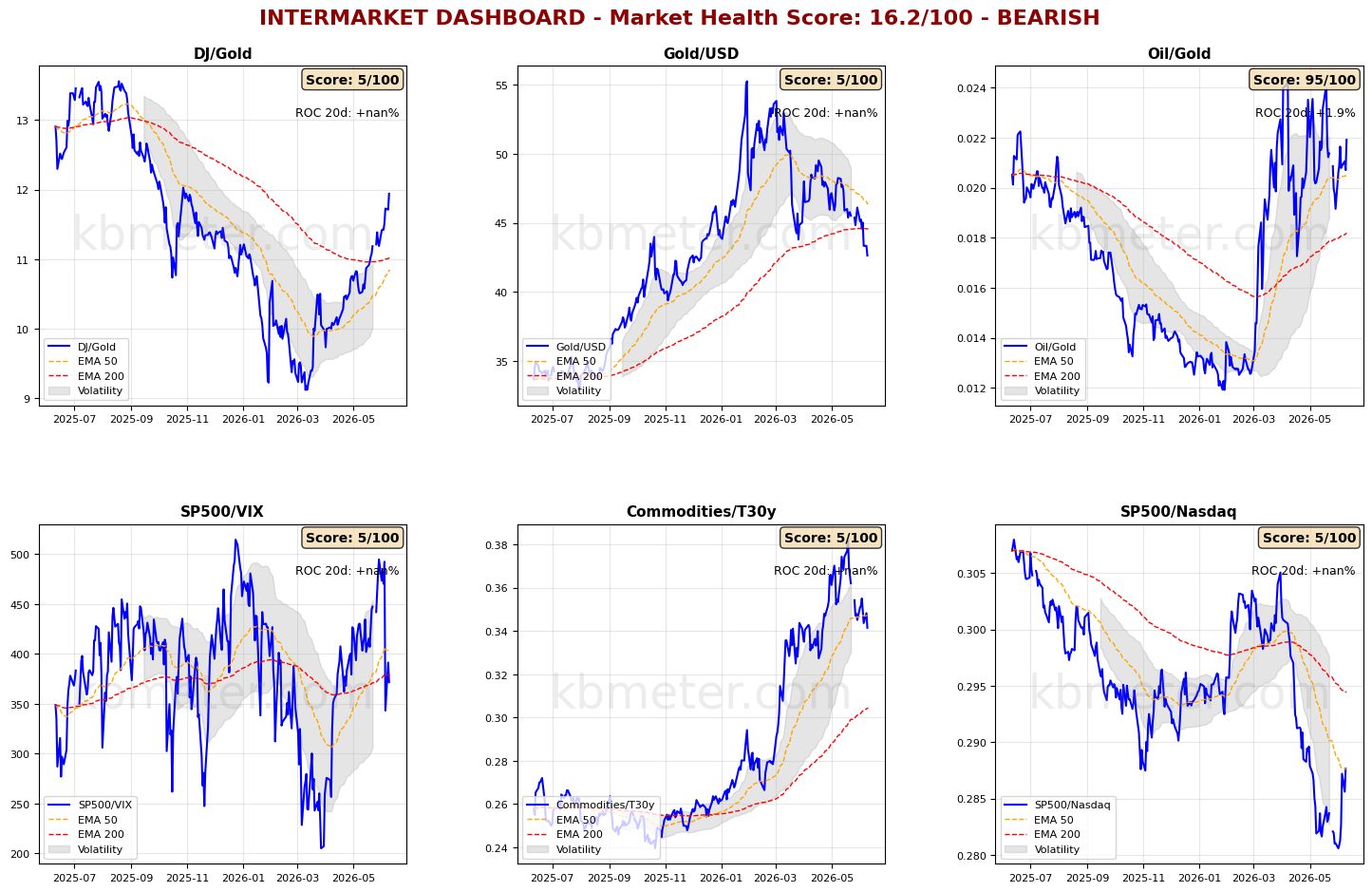
Financial markets are displaying a neutral sentiment today. Intermarket analysis shows a Market Health Score of 16/100, indicating a negative overall environment. Our intermarket dashboards reveal that many indicators are currently approaching key resistance and support levels. This suggests that financial markets may be entering a delicate and potentially decisive period for performance over the coming months.
The S&P 500/VIX ratio remains around its long-term moving average, while the S&P 500/Nasdaq ratio has returned to late-April levels and is testing resistance represented by its medium-term moving average. It is also worth noting the continued strength of the U.S. dollar and the corresponding weakness in gold. Gold has now broken below its long-term moving average, with the next potential technical development being a bearish crossover between the 50-day and 200-day moving averages. Regarding inflation expectations, the intermarket indicator represented by the Commodities/Bonds ratio has retraced to its 50-day moving average and continues to fluctuate around that level for the time being.
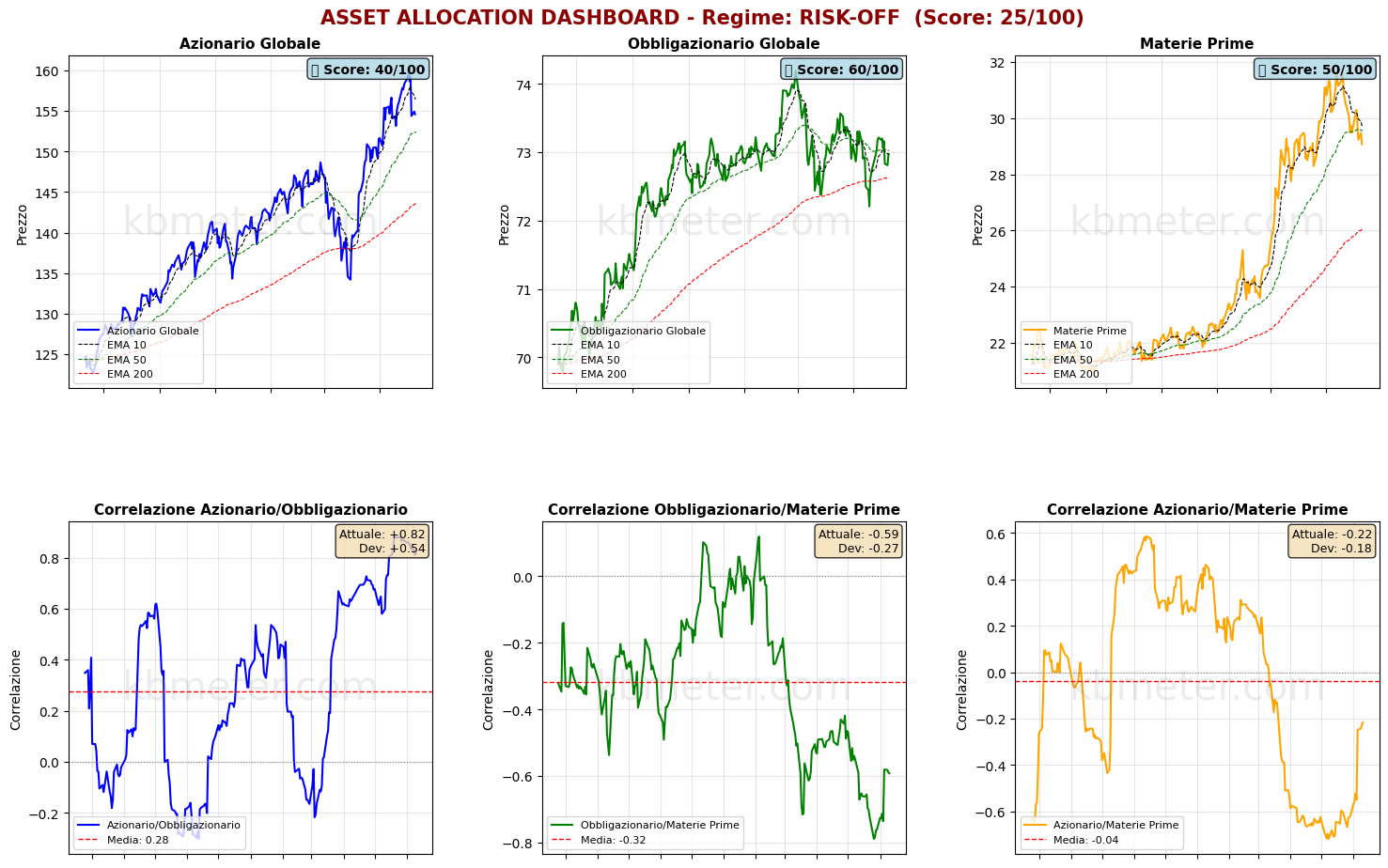
As for the major asset classes, there are no significant changes compared with previous analyses. We continue to observe price action around important support levels in both fixed income and commodities, while global equities—despite the weakness seen in recent sessions—remain above their medium-term moving average. Another noteworthy development is the weakening correlation between equities and bonds, although it remains strongly positive overall.
Finally, our market weather map shows that the entire equity market has fallen below the 50-point threshold, while the technology sector remains above neutral territory. The U.S. dollar is approaching a Health Score of 65 and has now recorded its seventh consecutive session above the 60-point mark. Fixed income markets, after rebounding at the end of May, have fallen back to their lowest levels since the beginning of the year.
Global Futures – Pre-Market Sentiment
Pre-Market Futures. Global futures indicate a moderately risk-off sentiment (-0.02% on average), with U.S. futures slightly positive (+0.48%), European futures slightly negative (-0.26%), and Asian futures marginally positive (+0.03%).
📊 Global Futures – Pre-Market Sentiment
- Nikkei 225 derived: +1.56%
- US Tech 100 derived: +0.69%
- Russell 2000: +0.51%
- Hang Seng derived: -0.88%
- IBEX 35 derived: -0.66%
- TecDAX derived: -0.64%
Macroeconomic calendar
On the macroeconomic front, today’s focus is squarely on the ECB meeting, where a rate hike is increasingly viewed as more than just a possibility. Investors will also monitor U.S. Producer Price Index (PPI) data for May 2026, as well as the latest U.S. unemployment claims figures.
Already a subscriber? Login here
NOTES AND WARNINGS
Data compiled by kbmeter.com. Analysis date: 11 June 2026 - 8:09 AM GMT+1
This content is provided for informational purposes only and should not be considered financial advice. All scores and assessments are based on the previous trading day’s closing prices. Futures indications refer to the date and time of the analysis.
