
Brazil’s Election Exposes Diverging Paths Across Latin American Equity Markets
The outcome of Brazil’s election does not appear to have been particularly well received by financial markets, but the situation remains fragile in Mexico and Argentina as well. Let’s look at what our health scores tell us about the main Latin American equity markets.
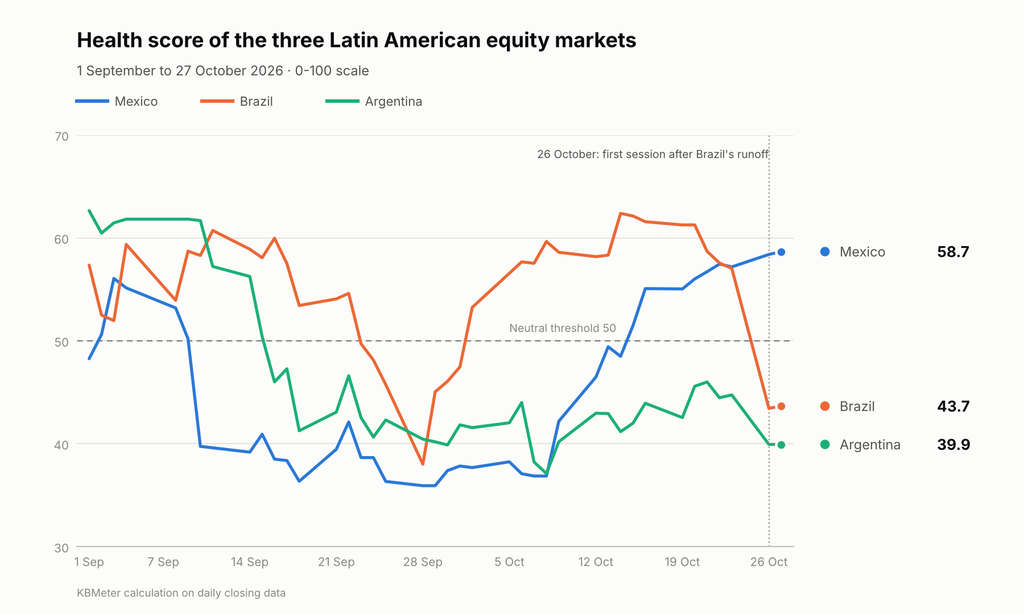
The three Latin American equity markets we monitor currently have widely diverging health scores: 58.7 for Mexico, 43.7 for Brazil and 39.9 for Argentina. Mexico is the only market above the neutral threshold of 50 and ranks in the 68th percentile of its one-year distribution. Brazil and Argentina are in the lower tail, at the 9th and 2nd percentiles, respectively.
| Market | Health Score | 1-Year Percentile | Current Regime | 5-Day Reliability |
|---|---|---|---|---|
| Mexico | 58.7 | 68th | Mixed (since October 13) | 55% |
| Brazil | 43.7 | 9th | Turbulence (since October 26) | 55% |
| Argentina | 39.9 | 2nd | Mixed (since October 9) | 80% |
Reliability indicates the percentage of comparable historical cases in which the score remained in the same category (Strong, Intermediate or Weak) after five days. It measures the stability of the state, not its direction.
What They Have in Common
All three markets experienced a period of weak momentum in the autumn, meaning a slowdown in the pace of price movements. Mexico’s momentum hit the lows of the period under review on September 14–16 and October 1, Argentina’s between September 28 and October 2, and Brazil’s on October 26.
Today, all three markets are trading below their 200-day moving averages: by 1.5% in Mexico, 7.8% in Brazil and 10.0% in Argentina.
🔒 Subscriber-only content. Activate 14-day free trial or Login here