
July 2026 Outlook: Markets at the Crossroads of Monetary Policy, Earnings and Growth
The July 2026 outlook for financial markets revolves around two key themes. The first is the U.S. equity market, where the slowdown in the technology sector has triggered a rotation that, for now, does not appear to be defensive in nature. The earnings season for the mega-cap technology companies at the end of the month will determine whether the current weakness remains an isolated correction or broadens into a wider market pullback.
The second theme is an unexpected shift in monetary policy. Both the Federal Reserve and the European Central Bank adopted a more hawkish stance during the same month, responding to the same energy shock stemming from developments in the Middle East. They must now decide whether the sharp decline in oil prices provides sufficient room to soften that stance. Against this backdrop, second-quarter 2026 GDP data could either validate or challenge the policy direction of both central banks. The U.S. dollar, trading at its highest level in more than a year, together with persistent weakness in gold, currently provides the clearest market signals.
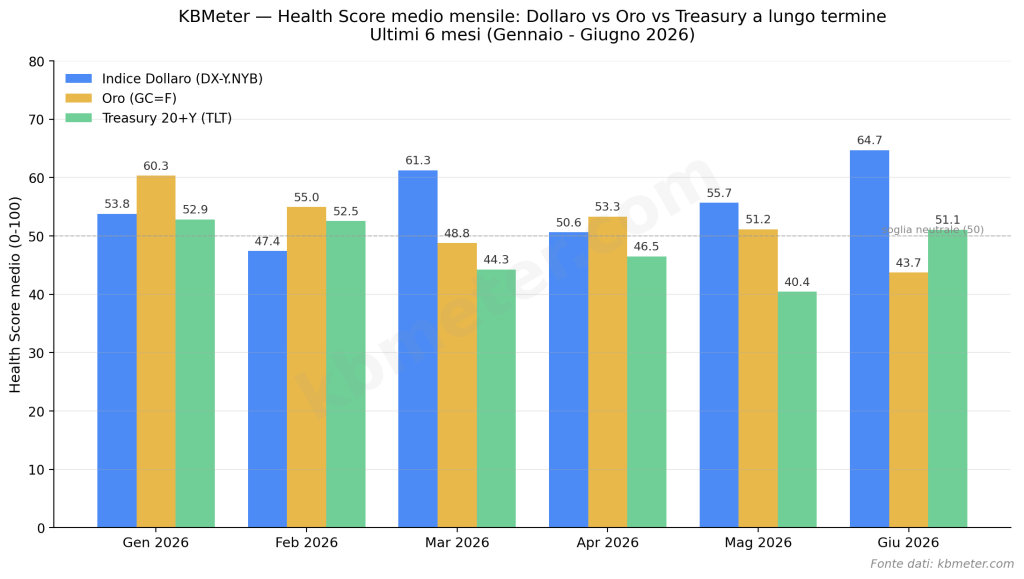
Current Market Environment: Surface Strength vs. Underlying Dynamics
On the surface, the market regime remains accommodative, characterized by a risk-on environment and the typical features of a mature expansion phase. Beneath the surface, however, the picture is more nuanced.
According to our proprietary scores, U.S. equities recorded one of the sharpest deteriorations across all major asset classes. Importantly, the weakness remains concentrated within the technology and growth segments, where investors are reassessing expectations surrounding artificial intelligence spending and its ability to generate returns. The broader market continues to perform well: industrials, financials, and small-cap stocks have emerged as relative leaders, with both the Dow Jones Industrial Average and the Russell 2000 ending June at new all-time highs.
European equities remain the strongest among the major regional markets. In Asia, broadly constructive price action coexists with an emerging weakness signal, creating a divergence that has yet to be resolved.
The most significant change has taken place in monetary policy.
🔒 Subscriber-only content. Activate 14-day free trial or Login here