
Energy Crisis Clouds Growth Outlook; High Yield Spreads Emerge as Key Risk Gauge
Financial markets are reacting to the energy crisis on multiple fronts, but the assessment of the negative effects on the global economy still appears relatively cautious. The divergence between the energy sector and high-yield bond prices is among the most significant features of this phase, yet High Yield spreads remain well below stress levels. Is this a positive signal, or have markets not yet fully priced in the cost of the crisis in the Middle East?
There is a fundamental difference between expensive energy driven by rising demand—an economy that is accelerating and consuming more—and expensive energy caused by constrained supply due to a geopolitical event. In the first case, it makes sense for high-yield credit to hold up: if the economy is strong, companies generate cash and service their debt. In the second case, the opposite applies: high energy prices do not signal prosperity—they tax it. Production costs rise, logistics costs increase, inflationary pressures build and keep interest rates elevated, and companies with weaker balance sheets find themselves squeezed from three sides at once.
The Strait of Hormuz is clearly not a demand issue. It is a matter of constrained supply, rerouted shipping lanes, soaring maritime insurance costs, and refineries under operational stress. Energy prices rising for these reasons act as a tax on the real economy, not as a sign of strength. Markets, at least partially, are beginning to recognize this—but not fully.
The divergence between Energy and High Yield Credit is emerging. HYG, the main ETF tracking U.S. high-yield corporate debt, has lost health, momentum, and technical positioning at a pace not seen since 2022. A particularly useful intermarket indicator to gauge how aware markets are of the risks to the real economy from the current geopolitical situation is the High Yield spread—that is, the premium investors demand to lend to riskier companies.
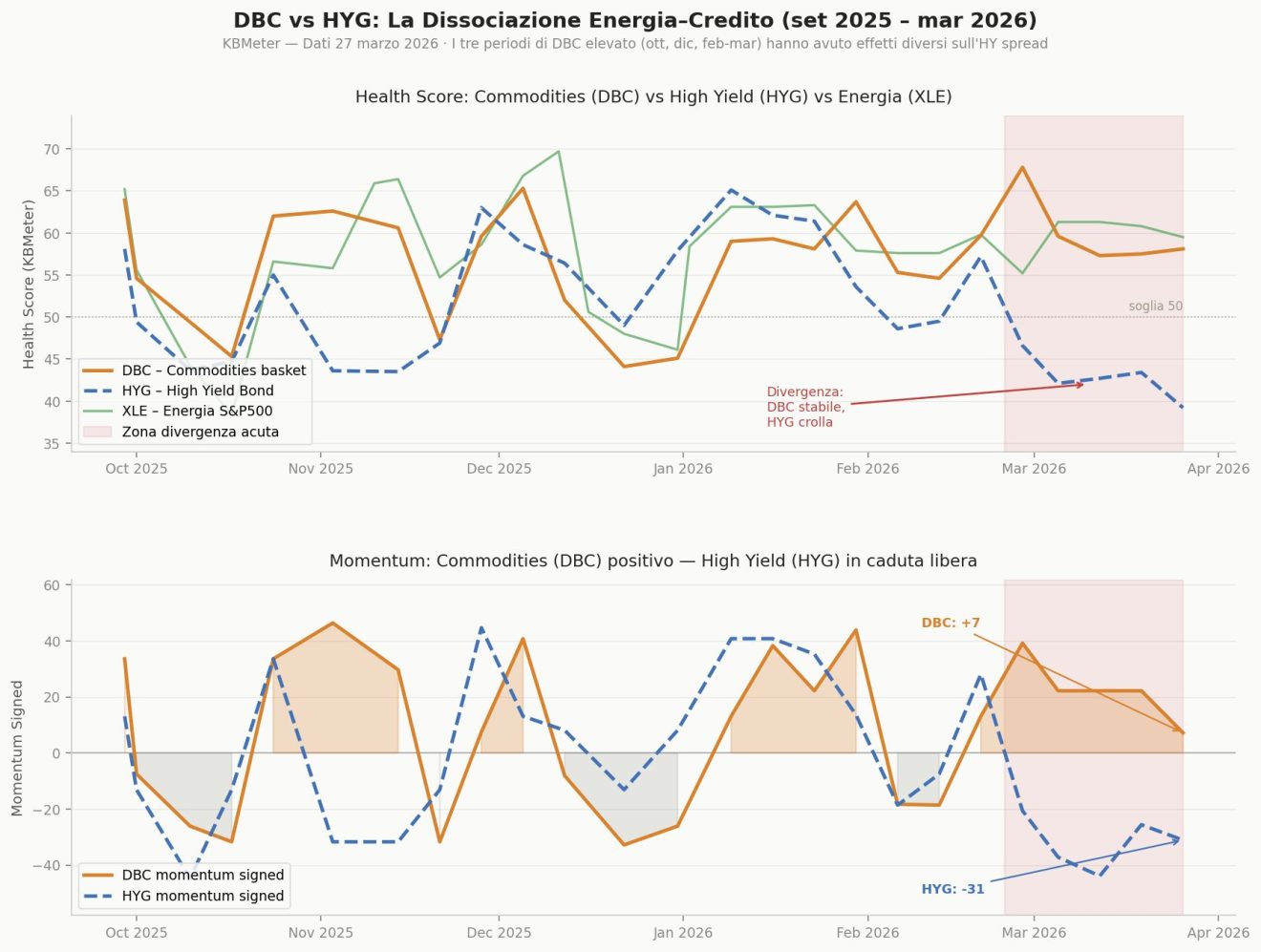
Before examining what the High Yield spread can tell us in more detail, it is important to understand how an energy shock of this magnitude transmits to the real economy.
The starting point is that an energy disruption caused by a geopolitical shock does not hit the economy all at once.
🔒 Subscriber-only content.
